
Book Review: Patterns, Principles, and Practices of Domain-Driven Design
A practical review of “Patterns, Principles and Practices of DDD,” helping developers and architects decide when Domain-Driven Design really pays off.

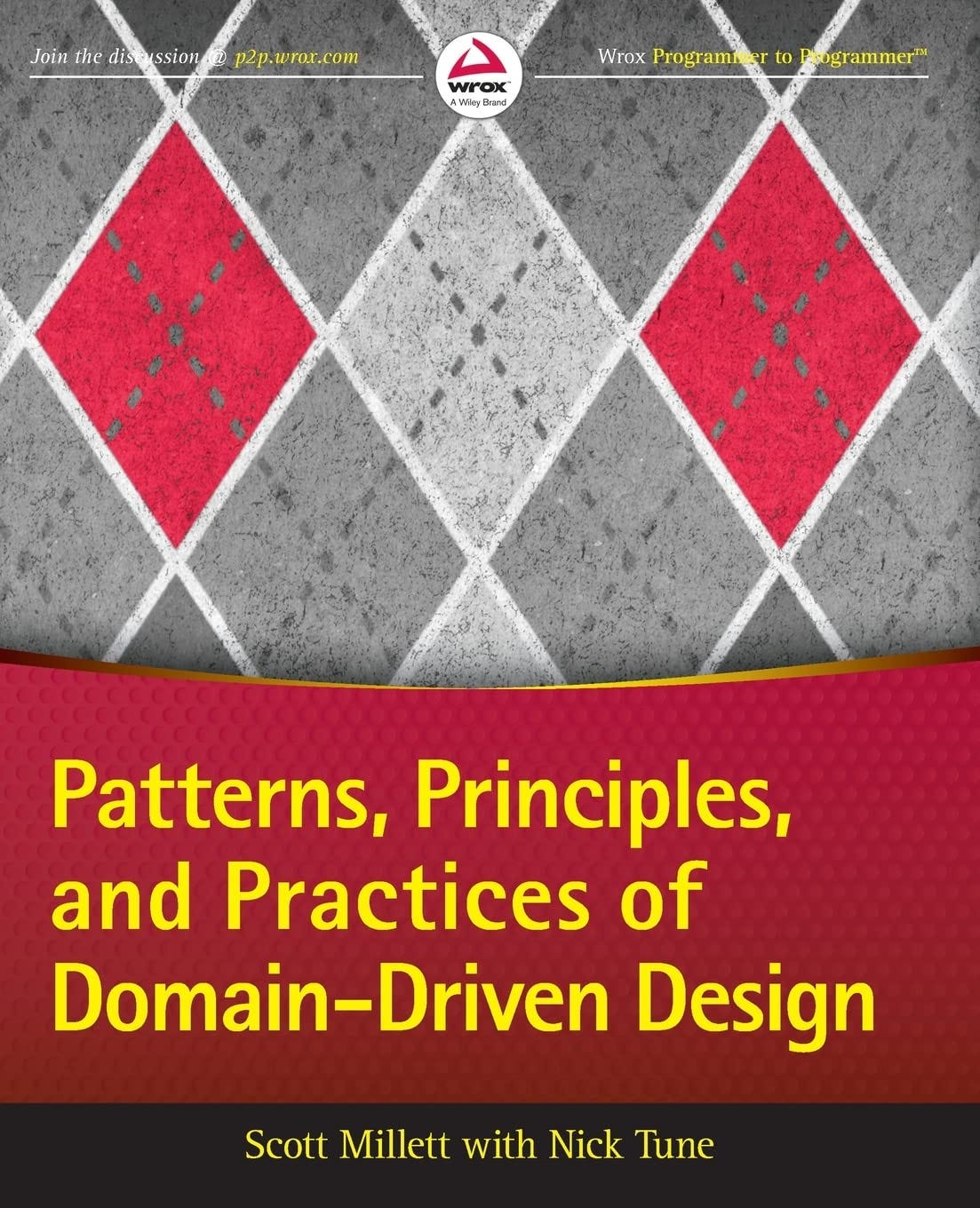
Overview
This book is a comprehensive, practice-oriented guide to Domain-Driven Design (DDD) that treats it less as a pattern catalog and more as a way of thinking about complex software. It moves from high-level principles (vision, subdomains, collaboration, ubiquitous language) through strategic patterns (bounded contexts, context maps, integration styles) down to concrete tactical building blocks (entities, value objects, aggregates, repositories, domain events). Throughout, it keeps asking a blunt question.
Is the extra complexity of DDD actually worth it here?
The primary audience is practitioners working in non-trivial domains: developers, tech leads, and architects who need to design systems that can evolve, collaborate with domain experts, and integrate multiple bounded contexts without turning everything into a Big Ball of Mud.
Part-by-Part
Part I – The Principles and Practices of Domain-Driven Design
What it’s about
Part I lays the philosophical and strategic foundation. It starts by explaining why complex systems decay: lack of a shared language, mixing domain logic with infrastructure, and trying to fit everything into a single generic model. It then introduces strategic vs. tactical DDD, the distinction between problem space and solution space, and the importance of “knowledge crunching” with real domain experts to distill subdomains into core, supporting, and generic. For example, turning a vague idea of “orders” into separate concepts like Quotes, Orders, and Shipments. You get model-driven design, bounded contexts, context maps, and a layered application architecture that keeps domain logic at the center. It closes by cataloging common failure modes for teams new to DDD and a pragmatic playbook for applying DDD only where it pays off.
Why it’s useful
This part is useful because it answers the questions most teams struggle with: Where should we invest modeling effort? How do we avoid another Big Ball of Mud? How do we sell this to the business? It gives you concrete tools: domain vision statements, core/supporting/generic subdomains, context maps, anti-corruption layers, and explicit guidance on when not to use a rich domain model or heavyweight DDD practices. It also surfaces the real drivers of success: access to genuine domain experts, iterative processes, and a motivated team with repeated reminders that patterns and frameworks are secondary.
Part II – Strategic Patterns: Communicating Between Bounded Contexts
What it’s about
Part II focuses on life after you’ve drawn boundaries: how bounded contexts talk to each other without collapsing into a single muddled model. It introduces relationship patterns like Shared Kernel, Customer–Supplier, Conformist, Partnership, Separate Ways, Anti-corruption Layer, and Open Host Service with Published Language, tying each to both technical integration and organizational power dynamics.
It then dives into integrating via messaging (commands, events, buses, gateways, UI composition, message versioning, monitoring, and scaling) and via HTTP, covering RPC and REST as integration mechanisms, including event-driven REST using hypermedia and Atom feeds.
Why it’s useful
Most DDD books hand-wave integration; this one stays grounded in reality. Imagine you own an upstream Pricing context and a downstream Billing context that must consume your changes without breaking. The book walks through what happens if Billing is Conformist versus protected by an Anti-corruption Layer. Part II shows that integration choices are not just about “REST vs messaging” but about upstream/downstream influence, collaboration level, and the cost of coupling. You learn when a Shared Kernel is worth the tighter coupling, when to accept a Conformist relationship to an external provider, and when to avoid integration entirely and go Separate Ways. The messaging and HTTP chapters translate these strategic ideas into concrete designs (eventual consistency, gateways for reliability, UI composition, backward-compatible message and API evolution, and metrics-driven operations) so you can keep contexts independent and ship features.
Part III – Tactical Patterns: Creating Effective Domain Models
What it’s about
Part III zooms into the code-level building blocks of rich domain models. It gives a structured overview of tactical patterns: entities, value objects, domain services, modules, aggregates, factories, repositories, domain events, and a brief introduction to event sourcing, explaining when and why to use each. A deeper dive into value objects shows how to represent descriptive, identity-less concepts with immutable, behavior-rich types, including patterns like static factories, micro (tiny) types, and collection aversion. The emphasis is on modeling behavior and invariants explicitly, keeping entities focused on identity, and using aggregates to define clear transactional and consistency boundaries.
Why it’s useful
Rather than throwing a diagram of “Entity/ValueObject/Aggregate” at you, this part explains how each pattern helps you express domain rules more clearly and make changes safer. You see how value objects can replace primitive fields to enforce constraints, how aggregates limit the blast radius of changes, how repositories should work at aggregate boundaries (not as generic CRUD), and where domain events help decouple behavior across aggregates. At the same time, the book keeps reminding you to apply these patterns selectively (only in complex, core areas) so you don’t turn every CRUD screen into an over-engineered science project.
How the Parts Fit Together
The three parts form a clear learning arc: see the domain, connect the contexts, implement the model. Part I teaches you to see your domain clearly, find the core, and draw boundaries around coherent models. Part II then shows how to connect those models across an organization without destroying their integrity, using explicit relationship patterns and integration technologies that match the power dynamics between teams. Part III finally gives you the tactical vocabulary to implement those models in code, keeping analysis and implementation aligned through ubiquitous language and model-driven design. Together, they move you from “Should we use DDD here?” to “How do we design, integrate, and evolve a DDD-inspired system in production?”
Strengths & Limitations
Strengths
Strong emphasis on strategy first: core domains, subdomains, bounded contexts, and context maps anchor all the later tactical advice.
Deeply pragmatic tone: repeatedly asks whether DDD’s complexity is justified, highlighting when simple CRUD, Transaction Script, or Active Record is the better tool.
Rich toolbox of collaborative techniques (Event Storming, impact mapping, BDD, CRC cards, rapid prototyping) that make “knowledge crunching” concrete rather than mystical.
Integration coverage is unusually thorough, blending organizational patterns (Customer–Supplier, Partnership, Conformist) with technical ones (messaging, HTTP/REST, gateways, UI composition, versioning).
Limitations
The examples and operational guidance lean heavily on specific technologies (e.g., NServiceBus, MassTransit, ASP.NET Web API), which may feel skewed toward certain stacks even though the principles are more general.
The breadth of concepts (strategic, tactical, organizational, and infrastructural) may overwhelm readers looking for a narrowly focused code-level introduction to DDD.
Who Should Read This
Software architects and senior developers working in complex, evolving domains that need a coherent way to tie architecture, modeling, and integration together.
Tech leads and team leads who suspect “DDD” is more than entities and repositories, and want a principled guide to where it actually creates value.
Engineering managers and technical leaders who need to explain DDD in business terms (value, risk, speed, cost) and decide when to invest in it and when to keep things simple.
Teams that have tried “DDD lite” (just tactical patterns) and ended up with over-engineered code, and now want to understand collaboration, language, and context as the real levers.
Conclusion
Patterns, Principles and Practices of Domain-Driven Design is a broad, opinionated walkthrough of DDD as a whole ecosystem: from how you talk with experts and carve out core domains to how you integrate bounded contexts and write supple code with value objects and aggregates. It’s best suited to practitioners tackling genuinely complex domains who are willing to think hard about trade-offs rather than chase purity. If you want one book that challenges you to apply DDD selectively, strategically, and in collaboration with your business, this is a strong choice. It treats DDD as a tool, not a religion.
Want to learn more?
🎓 Check out the courses: See on Udemy
🌐 Follow us on LinkedIn: Software Architecture Guild
📖 Explore the Guide: Jump to Website
Fantastic breakdown of when DDD actually makes sense versus when it becomes overkill. The way the book frames bounded context integration alongside organizational power dynamics is someting I wish I'd understood earlier at my last company. We tried forcing rich domain models on what was basically CRUD and it turned into such a mess. Really appreciate how pragmatic this reivew is about choosing the right tool.